
You know those marketing emails that feel like they were written just for you? The ones that recommend exactly what you were thinking about buying? That is not luck. That is customer segmentation done right.
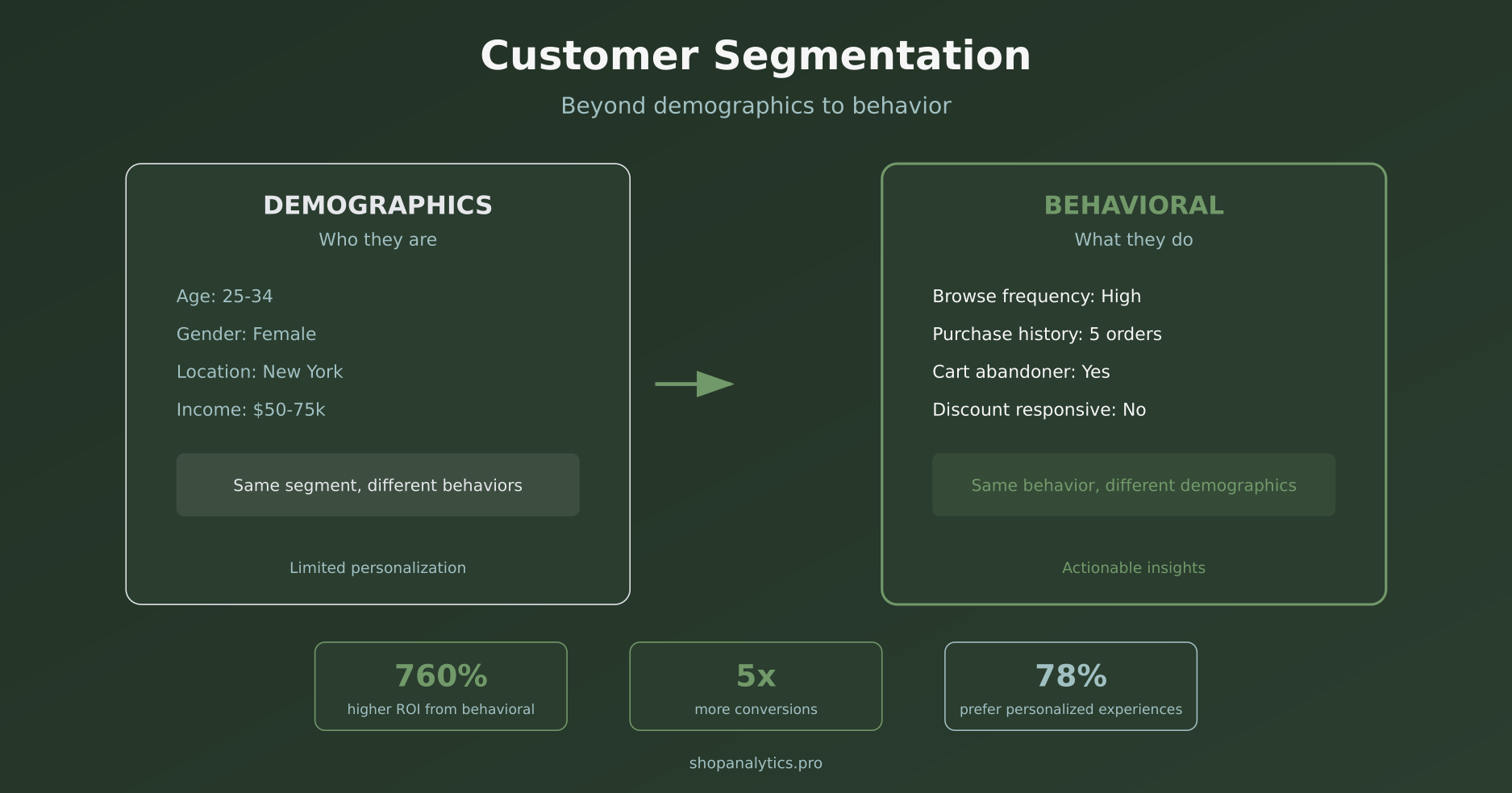
Here is the problem: most stores still segment customers by demographics. Age. Gender. Location. And then they wonder why their email campaigns underperform. The truth is, demographics tell you who someone is, but behavior tells you what they will actually do.
In this guide, I will show you how to move beyond basic demographic segmentation and build behavioral segments that drive real results. We will cover the segments every e-commerce store needs, how to collect the right data, and what to do with each segment once you have it.
Why Demographics Are Not Enough
Let me give you a scenario. You have two customers who are both 28-year-old women living in Chicago with similar incomes. Demographically identical. But one shops every week and spends big, while the other browsed once six months ago and never came back.
Should you send them the same email? Obviously not. Yet that is exactly what happens when you rely on demographics alone.
Behavioral segmentation flips the script. Instead of grouping people by who they are, you group them by what they do:
- How recently they purchased
- How often they buy
- How much they spend
- What they browse but do not buy
- How they respond to emails and offers
This approach delivers results because behavior predicts future behavior. Someone who bought three times in the last month is far more likely to buy again than someone who matches their demographic profile but has never purchased.
The 6 Behavioral Segments Every Store Needs
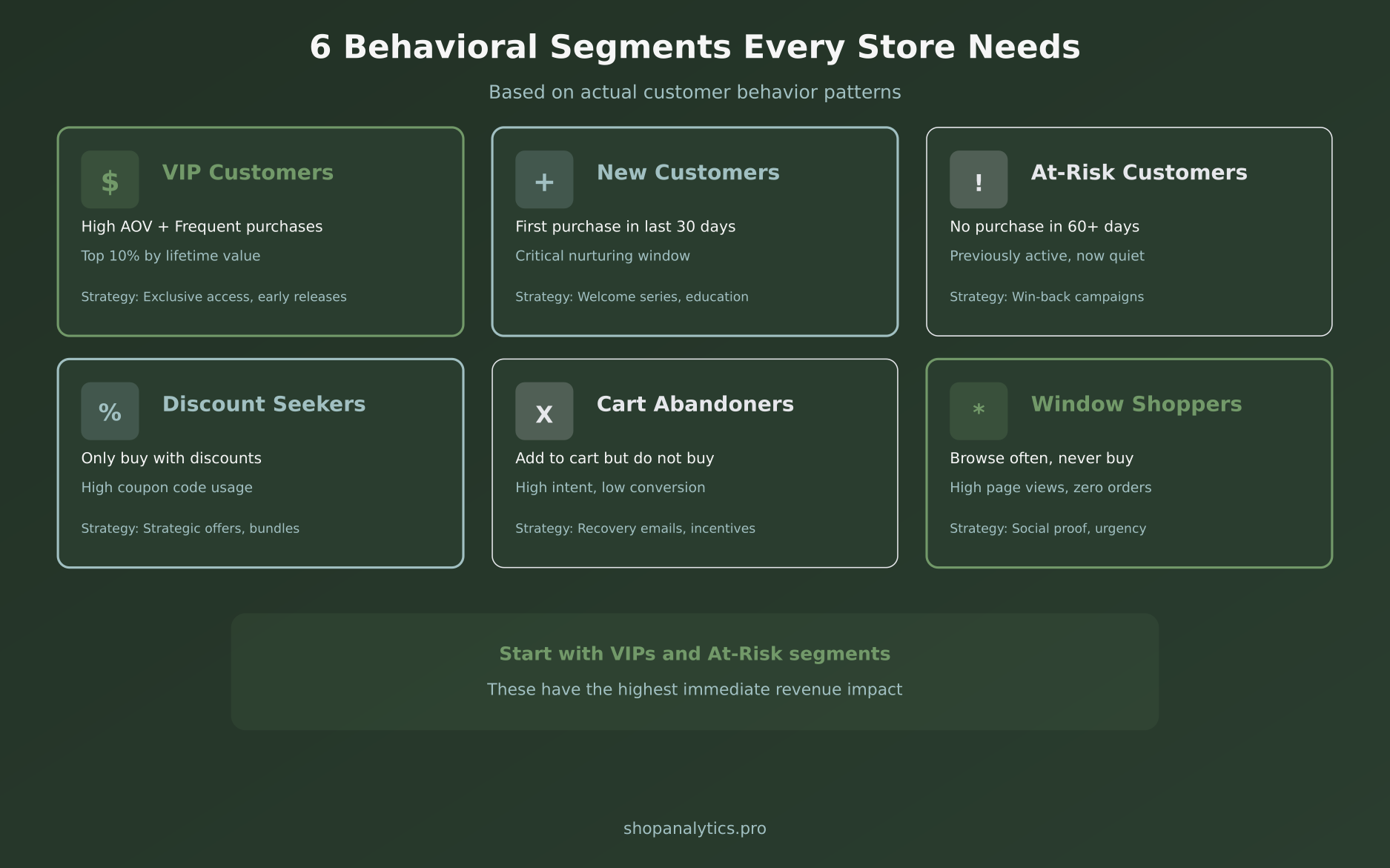
You do not need dozens of segments to get started. These six cover the most important customer behaviors and give you a clear action plan for each group.
1. VIP Customers
Definition: Your top 10-20% by lifetime value. High average order value plus frequent purchases.
These customers are the backbone of your business. They buy often, spend big, and rarely need discounts to convert. In most stores, VIPs generate 50-80% of total revenue despite being a small fraction of customers.
What to do:
- Give them early access to new products and sales
- Create exclusive offers just for them
- Reach out personally for feedback
- Never blast them with generic promotional emails
2. New Customers
Definition: Made their first purchase in the last 30 days.
The first 30 days after a purchase are critical. This is when customers form opinions about your brand and decide whether to come back. Most stores completely ignore this window, and it costs them.
What to do:
- Send a welcome email series that educates, not just sells
- Share your brand story and values
- Offer help with their first purchase (sizing guides, how-to content)
- Incentivize the second purchase before the momentum fades
3. At-Risk Customers
Definition: Previously active customers who have not purchased in 60+ days.
These are customers who used to buy but have gone quiet. They know your brand, they have purchased before, and something changed. Maybe they found a competitor. Maybe they just forgot about you. Either way, they are slipping away.
What to do:
- Launch win-back campaigns with compelling offers
- Ask what went wrong (surveys can reveal issues you did not know about)
- Show them what is new since they last visited
- Make the offer time-limited to create urgency
4. Discount Seekers
Definition: Customers who only buy when there is a discount or coupon code.
Some customers have trained themselves (or you have trained them) to wait for sales. They never pay full price. This is not necessarily bad – they are still customers – but you need to handle them differently.
What to do:
- Focus on bundles and value offers instead of straight percentages off
- Use loyalty points that feel like rewards, not discounts
- Test gradually weaning them off constant promotions
- Accept that some customers will always be discount-driven
5. Cart Abandoners
Definition: Customers who add products to cart but do not complete the purchase.
This is one of the most valuable segments because intent is already proven. They wanted to buy. Something stopped them. We covered the 12 reasons this happens in our cart abandonment guide – the solutions are straightforward once you understand the causes.
What to do:
- Set up an abandoned cart email sequence
- Start with a reminder, add social proof, then offer an incentive
- Use retargeting ads for high-value carts
- Analyze why they abandoned to fix systemic issues
6. Window Shoppers
Definition: Visitors who browse frequently but have never purchased.
They come to your site. They look at products. They leave. Over and over. Something is holding them back from that first purchase – maybe price, maybe trust, maybe they just have not found the right product yet.
What to do:
- Offer a first-time buyer discount
- Show social proof prominently (reviews, testimonials)
- Create urgency with limited-time offers
- Recommend entry-level products with lower risk
RFM Analysis: The Simplest Segmentation Framework
If you want a data-driven approach to customer segmentation, RFM analysis is the place to start. It scores customers on three dimensions that predict future behavior.
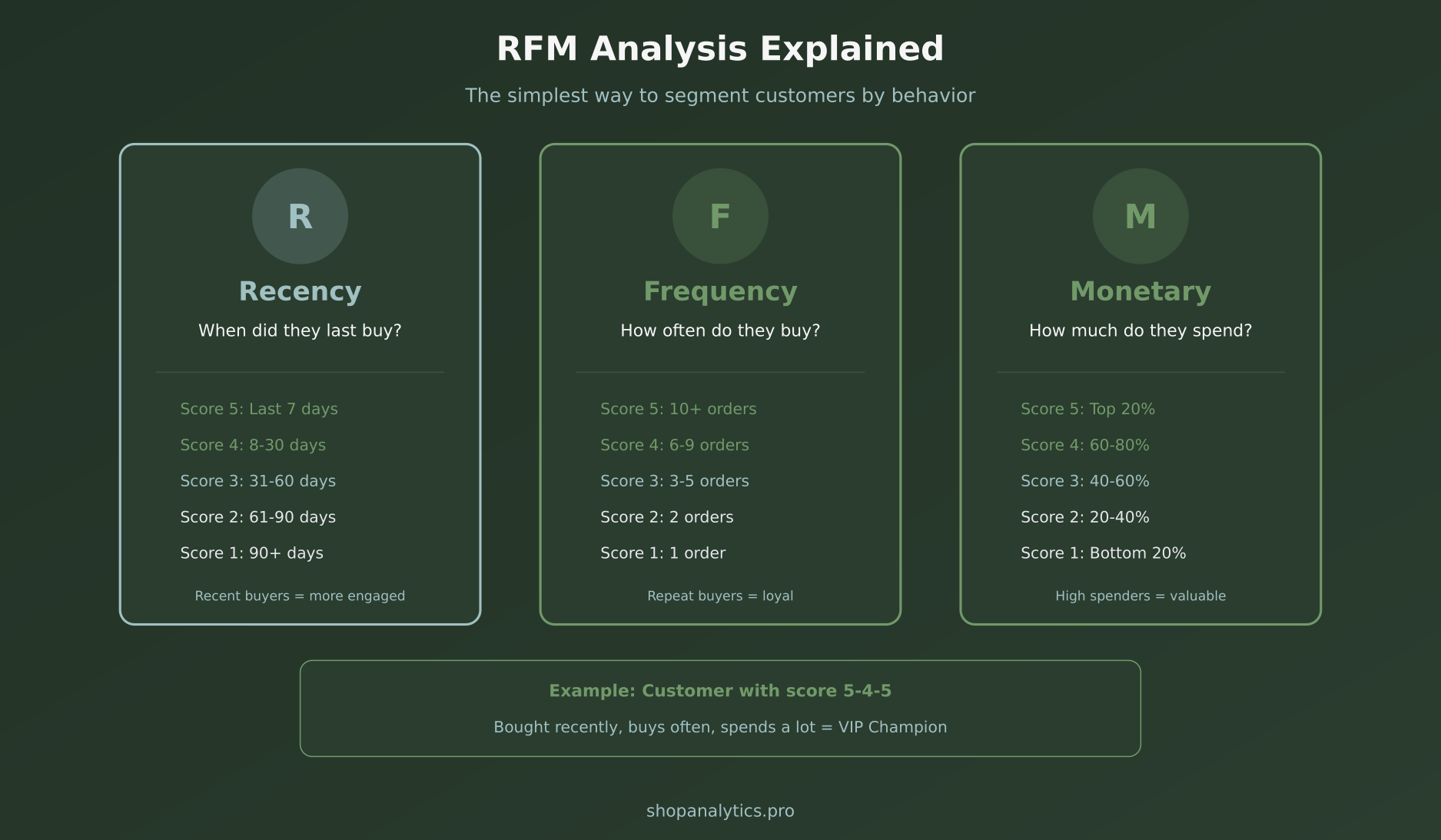
R – Recency: When did they last purchase? Recent buyers are more engaged and more likely to buy again.
F – Frequency: How often do they buy? Repeat purchasers are loyal and valuable.
M – Monetary: How much do they spend? High spenders have the most direct revenue impact.
You score each customer from 1-5 on each dimension. A customer with a score of 5-5-5 is your champion – bought recently, buys often, spends a lot. A customer with 1-1-1 is at serious risk of being lost forever.
The beauty of RFM is its simplicity. You can calculate these scores in a spreadsheet using order data you already have. No fancy tools required. For a product-level view that complements your customer segments, our ecommerce merchandising dashboard shows which products and categories drive the most revenue.
What Data Do You Need for Behavioral Segmentation?
Good segmentation requires good data. Here is what to collect and where to find it.
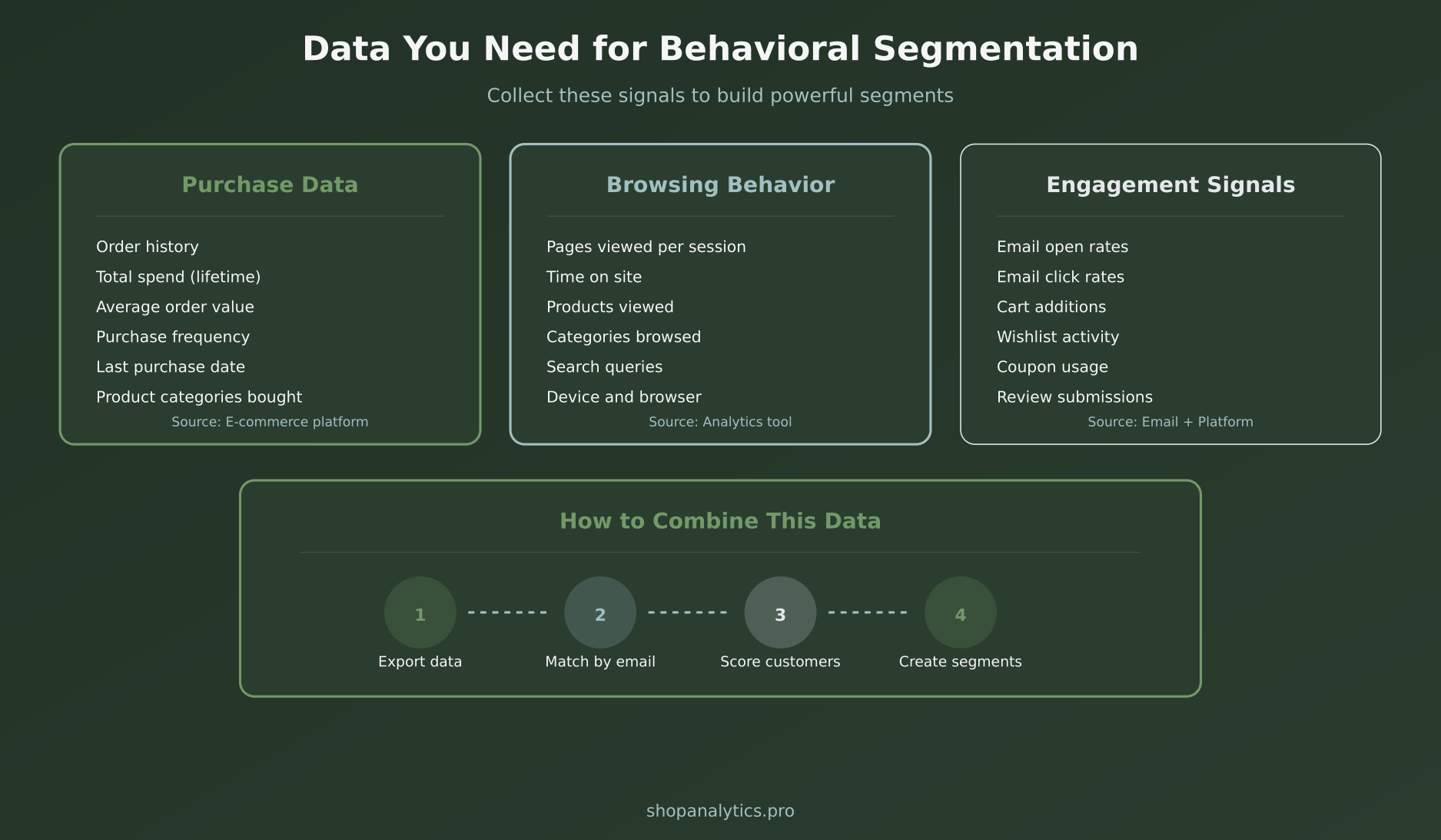
Purchase Data (from your e-commerce platform)
- Complete order history
- Total lifetime spend
- Average order value
- Purchase frequency
- Date of last purchase
- Product categories purchased
Browsing Behavior (from your analytics tool)
- Pages viewed per session
- Time spent on site
- Products viewed
- Categories browsed
- Search queries used
- Device and browser information
Tracking these behaviors properly is essential. Our guide to e-commerce event tracking covers the specific events you should be capturing.
Engagement Signals (from email and platform data)
- Email open and click rates
- Cart additions without purchase
- Wishlist activity
- Coupon code usage
- Review submissions
These signals are the micro-conversions that indicate purchase intent. They help you understand not just who bought, but who is getting close to buying.
How to Build Your First Behavioral Segments
Ready to get started? Here is a practical approach that works for stores of any size.
Step 1: Export Your Customer Data
Pull a customer export from your e-commerce platform that includes email, order count, total spend, and last order date. This is enough for basic RFM segmentation.
Step 2: Calculate RFM Scores
In a spreadsheet, rank customers into quintiles (five groups) for each dimension. The top 20% by recency get a score of 5, the next 20% get a 4, and so on.
Step 3: Create Your Segments
Combine scores into meaningful groups:
- Champions (5-5-5, 5-4-5, etc.): Your VIPs
- Loyal (X-4-4, X-5-4): Frequent buyers with good spend
- At Risk (1-X-X, 2-X-X): Have not bought recently
- New (first purchase in last 30 days): Needs separate nurturing
Step 4: Sync Segments to Your Email Tool
Most email platforms allow you to import customer tags or create segments based on custom fields. Upload your segment assignments and start creating targeted campaigns.
What to Do With Each Segment
Segmentation is only valuable if you act on it. Here are the specific strategies for each segment.
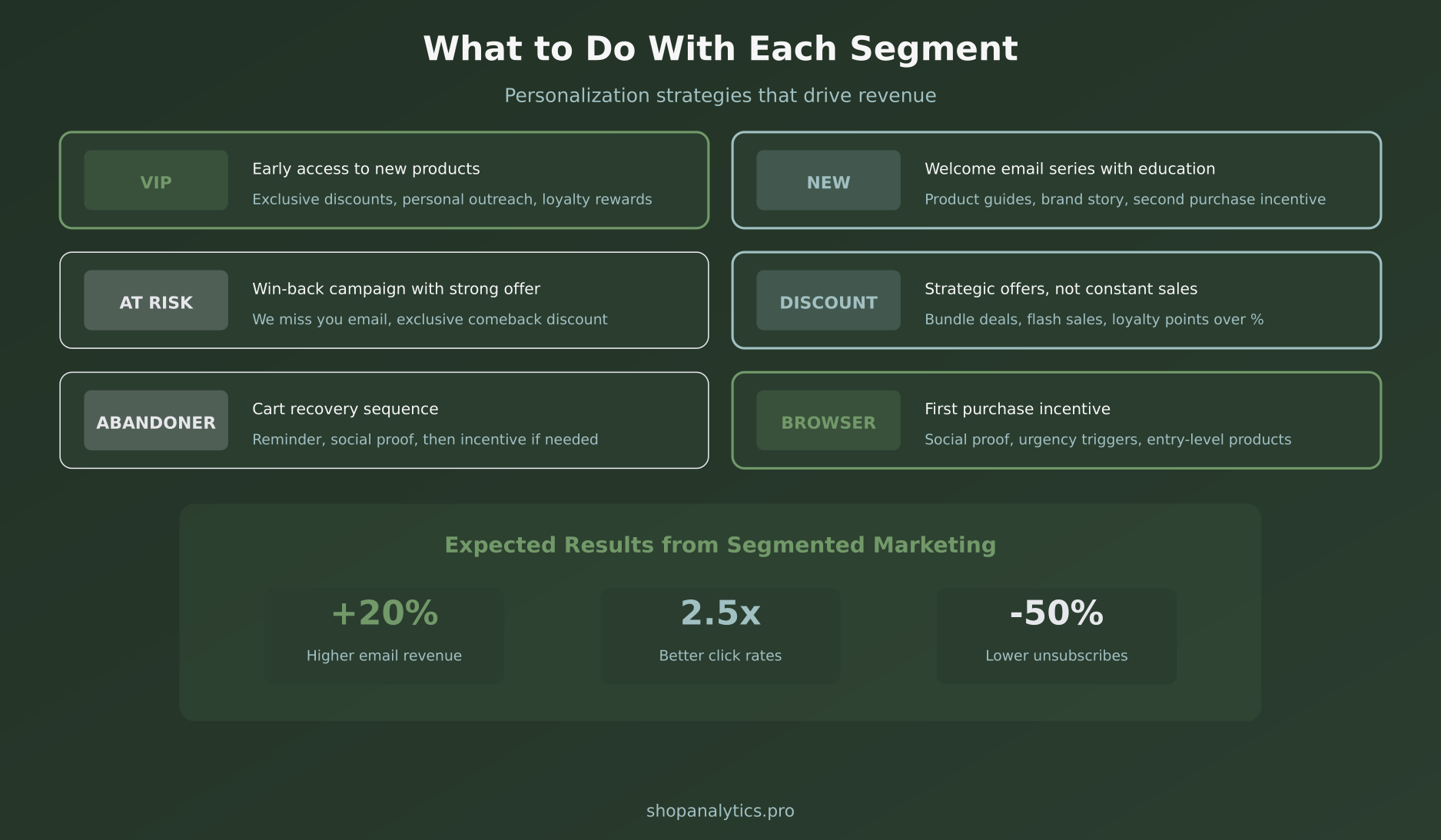
The key is matching your message and offer to each segment’s behavior. VIPs do not need discounts – they want exclusivity. At-risk customers need a compelling reason to come back. New customers need education and relationship building.
This is where segmentation pays off. Instead of sending the same email to everyone, you send the right message to the right person at the right time.
Common Customer Segmentation Mistakes
Before you dive in, here are the pitfalls to avoid.
Creating too many segments: Start with 4-6 segments. You can always add more later. Too many segments means too little time to create quality content for each.
Segmenting without action plans: Every segment needs a strategy. If you do not know what to do with a segment, do not create it yet.
Set and forget: Customer behavior changes. Recalculate your segments at least monthly to keep them fresh.
Ignoring small but valuable segments: Your VIP segment might be small, but they drive outsized revenue. Do not neglect them just because there are not many of them.
Key Takeaways
Customer segmentation based on behavior is more powerful than demographics because actions predict future actions. Here is what to remember:
- Start with six core segments: VIPs, New, At-Risk, Discount Seekers, Cart Abandoners, and Window Shoppers
- Use RFM analysis (Recency, Frequency, Monetary) for a simple, data-driven approach
- Collect purchase data, browsing behavior, and engagement signals
- Every segment needs a specific strategy – no generic blasts
- Start simple with 4-6 segments and add complexity over time
- Recalculate segments monthly as customer behavior changes
The stores that get customer segmentation right see dramatically better email performance, higher customer retention, and more efficient marketing spend. It takes effort to set up, but the payoff is worth it.

Sophie Andersson
Technical marketer with 7+ years in e-commerce growth teams. Started as a developer, moved into marketing, and now lives at the intersection of both worlds. Believes that good analytics shouldn't require a PhD to understand.
More about me →